Do not decide whether an AI answer is usable from how fluent it sounds or whether it includes a link. First identify what kind of claim it makes, then use a matching check. If the important part cannot be supported, keeping it as “unconfirmed” is more responsible than forcing a conclusion.
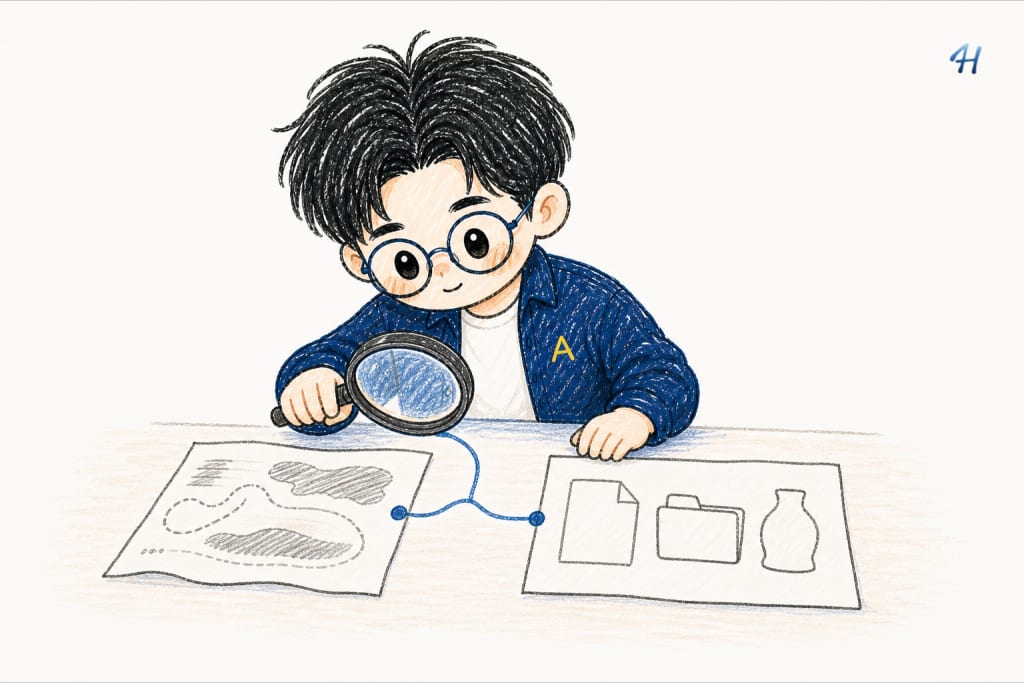
“Does AI hallucinate?” is a broad question. At work, the useful question is narrower: can I use this sentence now? My answer is that a date, a calculation, a quotation, a judgment, and a recommendation should not be checked in the same way.
Five claim types need five different checks
| Claim type | Example | Minimum check | | --- | --- | --- | | Fact | Event date, job title, product specification | Return to the original announcement or primary source. | | Calculation | Total, growth rate, ranking | Keep the inputs and recalculate the formula and denominator. | | Quotation or source | “A report says…” | Open the original and check author, date, wording, and context. | | Judgment | “A is better than B” | Check the criteria, omitted conditions, and trade-offs. | | Action recommendation | “We should do this now” | Check who has authority, whether the consequence is reversible, and whether specialist review is needed. |
This is a teaching taxonomy, not a product guarantee. It turns “this sounds right” into a concrete next check.
A small example shows why a polished answer is not enough
Suppose the only source says: “An online product briefing takes place on September 12. Registration closes September 8.” It does not name a speaker, price, or recording.
If AI writes that a product lead will speak, attendance is free, and a recording will be available, only the date and registration deadline can be traced to the source. Remove the unsupported additions, label them “not stated,” or return them to the person who owns the information.
A URL is a starting point, not a verdict
When an answer cites a source, check that it exists, that the author and date match, that the source supports the actual wording, and that related information has not been rewritten as a causal conclusion. Asking another AI for the same answer can surface questions, but it does not become independent verification.
Save the verification, not just the answer
Claim in the output:
Claim type:
Original source or input:
Check performed:
Result: supported / unsupported / unconfirmed
Person responsible for confirmation:
Uncertainty that remains:
For work that affects customers, budgets, contracts, people, health, law, or safety, this record does not make the decision for you. It makes it harder to hand a decision to a fluent draft by accident.
Use the surrounding methods when they are the real gap
Related official documentation
Product documentation can explain how a service accepts instructions and context, but it cannot prove a specific answer is true. These links are product-level reading, not an endorsement of this five-check method.
- OpenAI: Prompt engineering
- Anthropic / Claude: Prompting best practices
- Google / Gemini: Prompt design strategies
Related reading: Define the work before tuning the prompt, AI meeting notes and data and authority checks.