To organize a shared ChatGPT project, keep its reference material together, give each chat one task, and point teammates to one accepted deliverable. A Canvas is useful for editing a draft; a project is useful for keeping the work’s context. Neither replaces a clear current-version record.
A shared Canvas still needs a current-version record
For a team review, a Canvas and a project are different parts of the work. A Canvas can hold a draft; the project holds the surrounding conversations, instructions and sources. Give reviewers one explicit current file or Canvas link, then name the source version and the question they should decide. OpenAI’s Projects guide lists Canvas as a drafting tool. Use the sharing controls available in your interface; for collaborative editable pages, see Space sharing.
Try an event-planning handoff. Keep the original venue quotations under sources/, the working comparison under working/, and an accepted decision under outputs/. Record the current decision in a short entry:
Decision: choose the venue only after capacity is confirmed.
Current artifact: working/venue-comparison-v02.md
Sources: quotation-A.pdf, quotation-B.pdf
Unknown: maximum seated capacity for venue B
Next owner: event coordinator
Do not reuse: venue-comparison-v01.md
Before the review, ask a teammate to locate the current artifact using only that entry. If they choose v01 or cannot open a quoted source, repair the entry or access first. This tests the handoff itself; a more elaborate folder tree would not fix an ambiguous “latest version.”
If your question is about putting existing chats into a project, use the Projects setup steps. If the intended file is missing after the move, use the Sources and attachment checks.
When several tools need to continue a project, see Memory MCP's persistent memory file. For breaking a question into inspectable steps, see Sequential Thinking MCP's step records. Keep the authoritative deliverables and source files alongside either approach.
A handoff record for a distributed team review
For a team review, point readers to one approved artifact before sending them through the chat history. Use the following editorial template alongside the project, rather than expecting every teammate to infer the current decision from a long conversation.
Goal: [the decision or deliverable under review]
Current file: [approved location and version]
Sources used: [file names and dates]
Decisions confirmed: [decision and responsible person]
Questions still open: [question and owner]
Next action: [who does what, by when]
Access checked for reviewers: [yes/no/not yet]
A project name or chat title does not establish that reviewers can open the underlying files. Before the review, check the intended audience and keep superseded drafts labeled. This is a suggested review method, not a tested sharing configuration.
Give the project, chat and file different jobs
| Place | Name example | Keep here |
|---|---|---|
| Project | Customer onboarding | Shared goal, instructions and reference sources. |
| Chat | 2026-11-14 | compare options | One question or stage, with decisions returned to a file. |
| File | onboarding-decision-v02.md | Accepted result, source IDs and unresolved questions. |
Copy the check, then inspect the evidence
Before sharing, open the project as the intended recipient if you have an authorized test account. Check file access and remove irrelevant material. A chat title or folder name does not enforce access control.You may discuss one proposal across three conversations: the first contains the background, the second has the latest figures, and the third contains the decision. A week later, even you cannot tell which version is current.
The problem is not only that AI can forget. The work has no clear home. Give each location one responsibility.
OpenAI documents what ChatGPT Projects and Codex can hold and access. The division below—project for an ongoing goal, folder for durable material, conversation for a single stage—is my working method, not a product-mandated architecture.
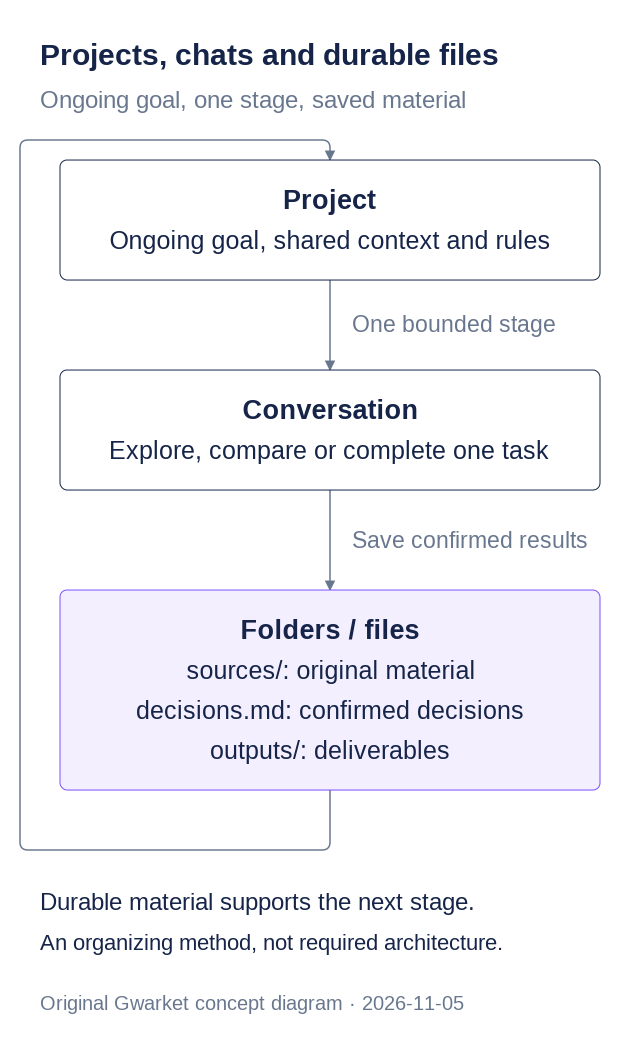
A project carries an ongoing goal
A project is useful when work continues across multiple conversations, shares source material, and needs the same goal or instructions: preparing for a job search, organizing a monthly reading group, or rebuilding a product website.
OpenAI describes ChatGPT Projects as workspaces that keep related chats, files, and project instructions together. Project instructions apply within that project. OpenAI: Projects in ChatGPT
A ChatGPT Project is not the same technical object as a local Codex folder or a Git repository. OpenAI also explains that Codex can work with local folders, repositories, terminals, and developer tools, while Codex history remains separate from ChatGPT history. OpenAI: ChatGPT Work and Codex
Start with one sentence:
This project exists to complete ______ over time. It does not include ______.Folders preserve material that must remain inspectable
An answer inside a chat is convenient, but it is a poor single source of truth. Requirements, sources, confirmed decisions, outputs, and version notes should be saved in files that you know how to review, back up, and share.
A minimal structure might be:
project-name/
  sources/       original material and references
  working/       drafts still being developed
  decisions.md   confirmed decisions with dates
  outputs/       deliverables
  README.md      current goal, entry point, and instructions
The names are optional. The essential boundary is that source material is not overwritten by a draft, confirmed decisions have a stable location, and another person does not need to read ten chats to find the current version.
A conversation should handle one clear stage
Use a conversation for exploration, comparison, review, or one bounded task. When the problem changes, open a new conversation so old constraints do not become tangled with the new objective.
One project might contain conversations for:
- organizing event requirements;
- comparing three public venue options;
- reviewing the final invitation.
Before closing a conversation, move durable results back to the project. Write approved decisions into decisions.md, save deliverables under outputs/, and record unresolved questions as next steps. “I remember the AI said something about this” is not a project record.
Use three questions to choose the location
| Question | Best location |
|---|---|
| Does this work continue for weeks under one shared goal? | Project |
| Must this content be saved, versioned, reviewed, or delivered? | Folder or file |
| Is this one exploration, comparison, or local task? | Conversation |
Information can begin in a conversation, return as a file, and become part of a project’s durable context. These are not mutually exclusive containers. They form a path from exploration to preserved work.
For the setup steps in ChatGPT, see How to use ChatGPT Projects.
Practice: map one ongoing piece of work
Personal AI workspace map

Project name and ongoing goal:
Out-of-scope work:
Official folder location:
Where original material lives:
Where confirmed decisions live:
Where deliverables live:
Purpose of each current conversation:
What each conversation must save back:
Current-version entry point:
You are finished when you can close every conversation and still find the goal, sources, approved decisions, and current result from the folder.
The next lesson asks which instructions should remain across many tasks in a Project or AGENTS.md, and which requirements should stay temporary. ChatGPT Attachments Missing from Project Sources After Moving a Chat?
References
Diagram sources and verification date: November 5, 2026. The diagram and caption summarize this article’s organizing method; related product scope: OpenAI: Projects.
What we checked in this update
Documentation checked November 16, 2026; the event example is an authored handoff exercise. Shared accounts, Canvas sharing and automatic file synchronization were not tested.