If you can only pay for one: pick Google AI Pro (NT$650 a month in Taiwan) if your work lives in Gmail, Google Docs and Drive or your family wants to share it; pick Claude Pro (US$20 a month) if you mainly have AI edit code or long documents from the terminal; pick ChatGPT Plus (shown as $690 a month on the official pricing page in Taiwan, US$20) if you want image generation, voice, deep research and coding in one plan. The entry-level paid plans cost about the same. The real differences are how usage limits are counted, whether you can share the plan, and which ecosystem your files are in. If you only use AI a few times a week, the free tiers are enough.
This comparison is based on the official pricing pages and help centers of OpenAI, Anthropic and Google. Prices and plan details were checked on 2026-11-26, and we will update the page when they change. We did not test the three models against each other. The "How we use Claude Code and Codex" section describes our own site's workflow; it is a usage scenario, not a review.
ChatGPT vs Claude vs Gemini plan comparison
All three offer a free tier, an entry paid plan and high-usage plans. The table compares the entry paid plans most people choose between, as shown on the official pages from Taiwan.
| ChatGPT Plus | Claude Pro | Google AI Pro | |
|---|---|---|---|
| Monthly price (checked 2026-11-26) | $690 on the Taiwan pricing page (no currency code shown); US$20 | US$20; US$17/month billed annually (US$200 up front); excludes tax | NT$650 |
| Billing currency | Web subscriptions support TWD; in-app purchases are billed by Apple or Google in local currency | USD | TWD |
| How limits work | Chat limits vary by model; Codex and ChatGPT Work share an allowance with a 5-hour window and possible weekly limits; merged with ChatGPT from December | 5-hour limit plus weekly limit, shared across Claude apps and Claude Code | Compute-based, resets every 5 hours until the weekly limit; 4x the no-plan limit |
| Coding tool | Codex (more usage than Free) | Claude Code (not on Free) | Expanded access in Google Antigravity and AI Studio |
| Storage and extras | None | None | 5 TB storage, YouTube Premium Lite (varies by country) |
| Family sharing | No, Plus is for individuals | No, individual plan | Yes, up to 5 family members |
| Student offer (Taiwan) | No individual student discount on the pricing page | No standing discounts; education plans are signed by schools | University students: Google AI Plus free for one year, redeem by 2026-12-31 |
| Cheaper tier | Go: $270/month (may include ads) | None | Google AI Plus: NT$165/month |
| Next tier up | Pro: from $3,300/month (US$100, 200 or 500) | Max: US$100 (5x); Ultra: US$200 | AI Ultra: NT$3,300 (5x) or NT$6,500 (20x) |
| How to choose | You want a bit of everything, including Codex | You mostly code or write long documents with Claude Code | Your files are in Google, you want to share with family, or you need storage |
The ChatGPT figure is what the official pricing page displays in Taiwan without a currency code. OpenAI's multi-currency billing article lists TWD as a supported web billing currency and notes that localized prices may differ from converted US prices, so check the checkout page. Claude shows US dollar prices in Taiwan.
How the usage limits differ
- Claude Pro: a 5-hour limit plus a weekly limit with a fixed reset time per account, visible in Settings > Usage. Anthropic says "These limits are shared across Claude and Claude Code," so heavy Claude Code work during the day can leave less for chat at night.
- Google AI Pro: Google says Gemini limits are based on compute: complex prompts, long chats and features like Deep Research use more. Usage resets every 5 hours until you reach the weekly limit. Google publishes multipliers only: AI Pro is 4x and AI Plus 2x the no-plan limit.
- ChatGPT Plus: until December, regular chat is counted separately. Codex and ChatGPT Work share one allowance (OpenAI says agentic features such as ChatGPT for Excel join it once their pricing takes effect). Plus uses a 5-hour window and weekly limits may also apply; OpenAI gives only estimated ranges that vary by model and task size.
ChatGPT and Codex share limits from December
OpenAI's help article "Understanding ChatGPT and Codex usage limits" (updated 2026-11-25) says that starting in December, Plus, Pro and Business plans will share one usage allowance across ChatGPT and Codex, measured in tokens. Two details matter: "Instant chat will not draw from your usage," and combined remaining usage and reset times will show in Settings → Usage. OpenAI has not published the size of the combined allowance, and a small group of users may see the change before December. If you pay for Plus mainly for Codex, stop counting chat and coding as two separate budgets. Claude Pro already works this way.
Which plan fits your work
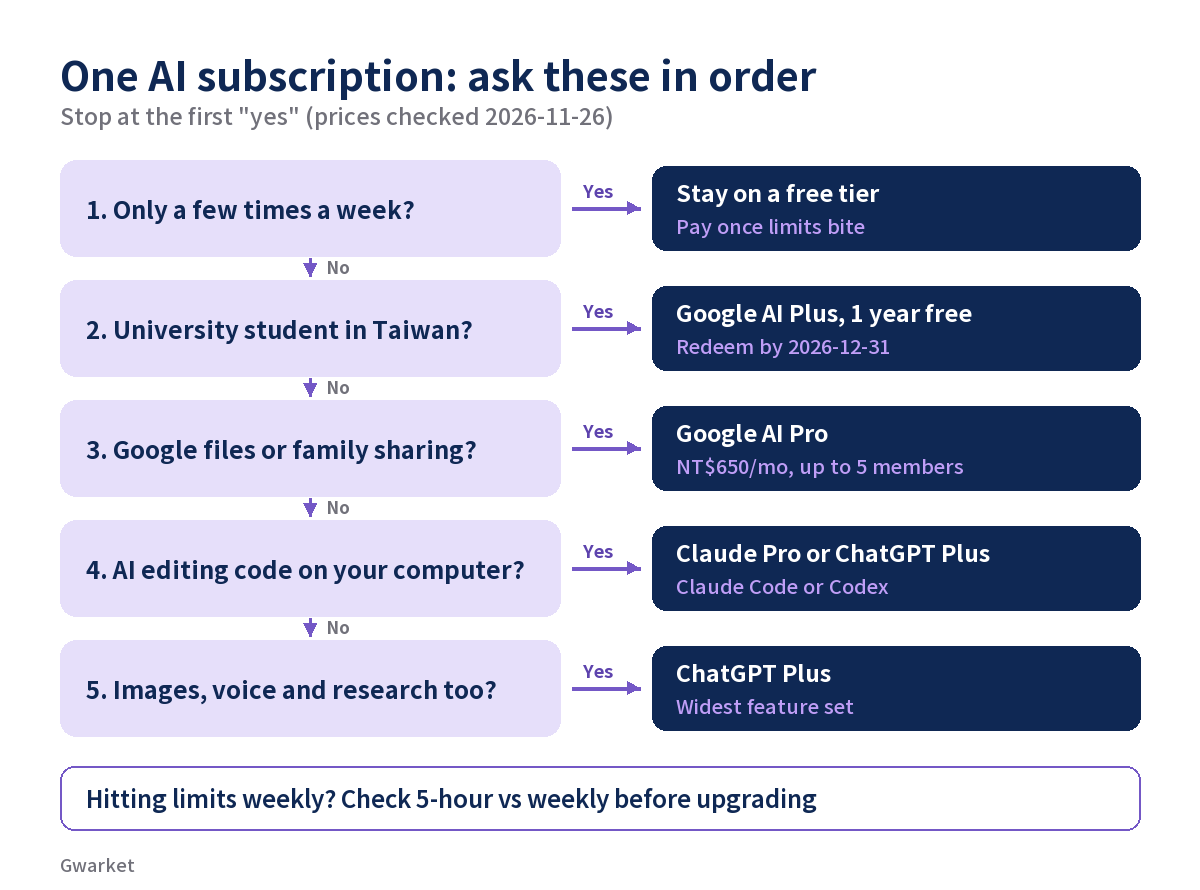
- A few questions a week → stay on a free tier. ChatGPT Free has unlimited text chat (with abuse guardrails); Claude Free has 5-hour and weekly limits and no Claude Code; Gemini without a plan may not offer compute-heavy features like Deep Research at peak times.
- University student in Taiwan → redeem the free year of Google AI Plus before 2026-12-31. It renews at NT$165 a month unless you cancel.
- Work in Gmail, Docs and Sheets, or a family that wants to share → Google AI Pro. Storage and AI benefits can be shared with up to five family members, which no other entry plan here allows.
- AI that edits files on your computer → Claude Pro (Claude Code) or ChatGPT Plus (Codex). Choose the interface you already work in; both share one allowance between chat and coding (ChatGPT from December).
- Images, voice, deep research and coding → ChatGPT Plus has the widest feature set.
- Hitting limits every week → check which one. If it is the 5-hour limit, split large tasks and spread them out. If it is the weekly limit, consider Max, Pro or Ultra, or two entry plans from different vendors.
How we use Claude Code and Codex (our scenario, not a review)
This is how Gwarket works day to day: writing articles, changing site code and running scheduled checks with AI.
- One paid plan does the main work. Our writing and site changes mostly run in Claude Code on a paid Claude plan. Because chat and Claude Code share limits, our rule is to stop heavy work once weekly usage passes 70% and keep the rest for necessary fixes.
- The other vendor's free tier is a backup. We use Codex on the free tier for small cross-checks only. OpenAI's December change names Plus, Pro and Business, so it does not affect free users.
- The weekly limit is the one that hurts. A 5-hour limit clears if you wait; a weekly limit can stop work until the weekly reset. We judge plans by weekly capacity, not by how many prompts fit in one sitting.
Family sharing and student plans
Only Google offers family sharing: its FAQ says Google AI Pro family members get the AI benefits at no extra cost, for up to five members. OpenAI says Go, Free and Plus are designed for individuals; shared use needs Business (two users minimum). Claude's Pro, Max and Ultra plans are individual; teams use the Team plan.
For students, Taiwanese university students can get Google AI Plus free for a year (verify with a school email, redeem by 2026-12-31, payment method required, renews at NT$165/month). Google's terms say the student offer does not apply to school-provided accounts, so use a personal Google account. OpenAI's education offers are ChatGPT for Teachers (US K-12) and ChatGPT Edu for institutions. Anthropic offers no standing discount on individual plans; Claude education plans are signed by schools.
Common misunderstandings
| Assumption | Official wording | What it means |
|---|---|---|
| In-app subscriptions cost the same as the web | Subscriptions through the app are "managed by Apple App Store or Google Play" and shown in your local currency | Compare the app price with the web price before paying |
| You can switch an existing ChatGPT subscription to TWD | You must cancel and resubscribe after the current billing period ends | Currency cannot be changed mid-subscription |
| Claude's US$20 is the final charge | "Prices shown don't include applicable tax" | Check the checkout page |
| A school Google account can claim the student offer | Not available for school-provided accounts | Use a personal account and verify with your school email |
| Claude Code and the Claude app have separate limits | "all activity in both tools counts against the same limits" | When Claude Code hits the 5-hour limit you may see "Usage limit reached · wrapping up" |
FAQ
Is the free version of ChatGPT, Claude or Gemini enough?
For a few questions or short edits a week, yes. ChatGPT Free has unlimited text chat but limited uploads, deep research and Codex. Claude Free has 5-hour and weekly limits and no Claude Code. Pay when you hit limits every week or need AI to edit files on your computer.
Can my family share one ChatGPT Plus subscription?
Not officially. OpenAI says Plus is for individuals; shared use requires Business (two users minimum). Of the three entry plans, only Google AI Pro shares AI benefits with up to five family members.
Will Codex use up my ChatGPT Plus chat allowance after December?
Yes, for non-Instant usage. From December, Plus, Pro and Business share one allowance across ChatGPT and Codex, but Instant chat does not count. Check Settings → Usage for combined remaining usage.
Related reading
- Not sure which ChatGPT surface fits your task? See ChatGPT Chat vs Work vs Codex: Choose by the Result.
- Before switching plans, check how ChatGPT data access changes across accounts and plans.
- Starting with Claude Code on Claude Pro? See the Claude Code tutorial: your first bug-fix task.
How we wrote this
Based on the official ChatGPT pricing page (Taiwan), OpenAI's help articles on ChatGPT and Codex usage limits and multi-currency billing, the Codex pricing docs, the Claude pricing page and Anthropic help articles on the Pro plan and Claude Code usage, the Google One AI plans page (Taiwan), Gemini's usage-limit help article, and Google Taiwan's official blog post on the student offer. Prices and plan details checked on 2026-11-26; we will update this page when they change. Not tested: we did not compare the three models' answers side by side. The "How we use" section is our own usage scenario, not a review.