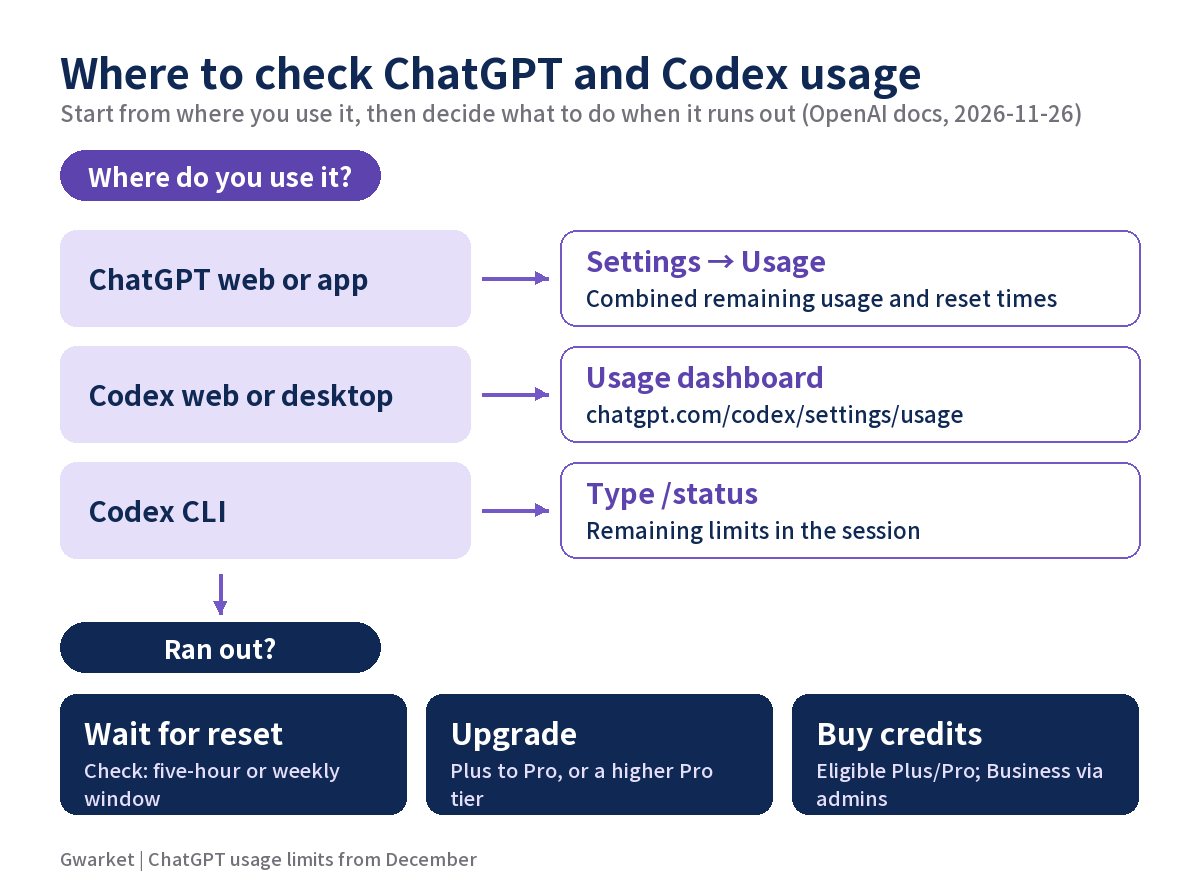
OpenAI's Help Center says that starting in December, Plus, Pro, and Business plans share one usage allowance across ChatGPT and Codex, measured in tokens. Instant chat does not count. Chatting with an advanced model, running a Work task, and coding in Codex all draw from the same pool. You check remaining usage and reset times in Settings → Usage, and when you run out you can wait for the reset, upgrade, or buy credits.
The people most affected are those who use both Codex and advanced-model chat heavily: chat and Codex used to be counted separately, and now a long day of Thinking chats can leave less room for Codex that evening. If you only use Instant chat, OpenAI's wording means you should not notice a change. Free, Go, Enterprise, and Edu are not covered by this notice, and OpenAI has not published the size of the shared allowance or how many tokens each kind of task uses.
This guide is compiled from the OpenAI Help Center, the ChatGPT release notes, and OpenAI's official pricing pages, current as of 2026-11-26. We have not tested it, because the change has not fully rolled out. Where OpenAI has not published something, we say so instead of filling the gap with numbers from other reports.
What changes in December
Work and Codex already share. OpenAI's Using Codex with your ChatGPT plan says Codex, ChatGPT Work, ChatGPT for Excel, and Workspace Agents use a shared allowance and credit pool, and the pricing page says "ChatGPT Work and Codex share pricing, credits, and usage limits." What December adds is regular ChatGPT chat.
From Understanding ChatGPT and Codex usage limits:
- Plans: Plus, Pro, and Business.
- Scope: one allowance across ChatGPT and Codex, as Work's agent features move into the main ChatGPT experience.
- Unit: tokens. Usage depends on the model you choose and the task; advanced models and complex tasks use more.
- Exception: Instant chat does not draw from your usage.
- Timing: starting in December, with a small group of users seeing it earlier for feedback.
OpenAI expects most users won't need to wait for resets more often than they do now. That is an expectation, not a guarantee.
What draws from the shared allowance
The "our reading" notes are our inference from OpenAI's wording, not something OpenAI states directly.
| What you do | Counts from December? | Official source | Not yet published |
|---|---|---|---|
| Instant chat | No | Help Center: "Instant chat will not draw from your usage." | Whether automatic reasoning while Instant is selected counts (the Business limits page says it may use your reasoning allowance) |
| Chat with Thinking, Pro, or other advanced models | Yes (our reading: only Instant is excluded, and usage depends on the model you choose) | Help Center | Tokens per message; whether current weekly message caps go away |
| Work tasks | Yes, already shared with Codex | Using Codex with your ChatGPT plan | Whether Work consumption changes |
| Local Codex tasks (app, CLI, IDE) | Yes | Pricing page: five-hour window for Plus and Standard Business; "Weekly limits may also apply" | Whether the five-hour and weekly windows stay after December |
| Codex cloud tasks | Yes, and possibly more than local | Pricing page: "Cloud tasks may use more of your allowance than local messages." | How much more |
| Codex Fast and Ultrafast modes | Yes, about 2–2.5x and 6–8x depending on model | Pricing page speed table | — |
| Image generation in Codex or Work | Yes, same pool as messages, used 3–5x faster on average | Pricing page: "Image generation counts toward the same general usage limits" | — |
| Voice in the Work or Codex desktop app | Metered separately; the pricing page bills it per minute against Codex usage | Using Codex with your ChatGPT plan; pricing page | — |
| File uploads, image generation, and voice in regular Chat | Separate limits today; regular Chat voice does not consume Codex usage | Using Codex with your ChatGPT plan; models page | How these count after December |
| How to choose | Keep everyday questions, edits, and translation on Instant; switch to an advanced model only when you need reasoning; check remaining usage before long Work or Codex jobs |
The row people overlook is advanced-model chat. It used to have its own cap; now it competes with Codex for the same pool.
Which plans are affected
Prices are USD list prices on OpenAI's pricing page, checked 2026-11-26.
| Plan | December shared allowance | What we know now |
|---|---|---|
| Free, Go ($8) | Not mentioned | Unlimited everyday text chats (subject to abuse safeguards); file uploads, image generation, voice, data analysis, and other tools have separate limits (models page, ChatGPT plans). Codex and Work listed as "Limited". Treatment after December not published |
| Plus ($20) | Yes | Codex has a five-hour window and may have weekly limits; eligible users can buy credits |
| Pro ($100 / $200 / $500) | Yes | Pricing page says Pro has no five-hour limit; the Oct 29 release note doubled Work and Codex usage for Pro 100 and Pro 500 and canceled an earlier Pro 200 reduction |
| Business (from $20/user) | Yes | Standard seats have a five-hour limit. Business workspaces created Nov 23–30 get double the weekly Work and Codex allowance through Dec 31 (Standard's five-hour limit still applies); existing and reactivated workspaces do not (Business limits, ChatGPT plans) |
| Enterprise, Edu | Not mentioned | Contract-based; flexible-pricing workspaces have no fixed rate limits |
How to check remaining usage and reset times
- ChatGPT web or app: Settings → Usage. OpenAI says the combined remaining usage and reset times will appear here.
- Codex web or desktop: the usage dashboard at
chatgpt.com/codex/settings/usage. - Codex CLI: type
/statusin an active session.
For token totals from your local Codex logs, see ccusage for Codex usage reports. It reads local logs, so its numbers are not the same as the remaining allowance on OpenAI's dashboard.
What to do when you run out
OpenAI lists three options: wait for the reset, upgrade your plan, or buy credits. Eligible Plus and Pro users can buy credits without changing plans; Business and Enterprise workspaces buy them centrally if admins allow it. The pricing page says credit prices depend on your plan or agreement and does not list a fixed rate.
If you hit a Thinking limit in chat, OpenAI's models page says ChatGPT may continue with another available model, so a sudden change in answer quality can mean you hit a cap.
Our view: if you hit the limit once or twice a month, wait. If it blocks work every week, compare credits against an upgrade.
How to adjust by usage pattern
These suggestions follow from OpenAI's rules; they are not test results.
Chat only: use Instant for everyday tasks and switch to Thinking only when you need reasoning. You are the least likely to notice the change.
Frequent Work users: Work already shared with Codex; now chat joins the pool. Check usage before big tasks, and settle the brief in Instant first so Work can finish in one pass.
Heavy Codex users: the biggest impact. On days with long Codex jobs, keep chat on Instant, run tasks locally instead of in the cloud when you can, use Fast or Ultrafast only when time matters, and run /status before long CLI jobs.
Does this change Chat vs Work vs Codex?
The rule for choosing stays the same: in ChatGPT Chat vs Work vs Codex we choose by the result you need to review. The one new factor is cost: when Work and Codex can both do a job, pick one rather than running both to compare, since both draw from the same pool. For turning Work tasks into reviewable output, see the ChatGPT Work tutorial.
Common misreadings
- "Every chat will count from December." OpenAI: "Instant chat will not draw from your usage."
- "Work and Codex start sharing in December." They already "use a shared allowance and credit pool." December adds ChatGPT chat.
- "Token-based means I can calculate my remaining messages." OpenAI has not published the pool size or per-task costs, and its per-five-hour message figures are estimates, "not fixed message limits."
What OpenAI has not published
As of 2026-11-26, we could not find these in the Help Center, release notes, or pricing pages:
- The size of the shared allowance and the gap between plans.
- Token costs per model or task.
- The exact December start date and rollout order.
- Whether Codex's five-hour and weekly windows remain.
- Whether Free, Go, Enterprise, or Edu change too.
- Whether file uploads, image generation, and voice in regular Chat join the shared pool.
FAQ
Does Instant chat count toward the limit from December?
No. The Help Center says Instant chat does not draw from your usage. The Business limits page notes that automatic reasoning may use your reasoning allowance even with Instant selected; how that works in the shared pool is not yet published.
Where do I check my ChatGPT usage?
Settings → Usage in ChatGPT, where OpenAI says combined remaining usage and reset times will appear. For Codex, use chatgpt.com/codex/settings/usage or /status in the CLI.
Do image generation, voice, and file uploads count?
It depends where. In regular Chat they have separate limits today, and regular Chat voice does not consume Codex usage. Image generation inside Codex or Work draws from the same pool as messages, 3–5x faster on average. How Chat's tools count after December is not yet published.
Will Plus users get less Codex?
OpenAI has not said the allowance shrinks, but chat now draws from the same pool, so frequent advanced-model chat leaves less for Codex. The real impact depends on the pool size, which is not published.
How we wrote this
Based on OpenAI Help Center articles Understanding ChatGPT and Codex usage limits, Using Codex with your ChatGPT plan, ChatGPT Business models and limits, and GPT-6 and other models in ChatGPT, the ChatGPT release notes, the Codex and Work pricing page, and ChatGPT plans. Data and prices as of 2026-11-26; the change has not fully rolled out. Not tested: we have not measured usage on an account under the new system. Rows marked "our reading" are our inference from OpenAI's wording.