Transformer Without the Math: What Attention and Embeddings Actually Do
The previous article asked an application-layer question:
What should the model see in this inference?
Once information enters the context window, another question appears:
How does the model process relationships among those tokens?
This is where three terms often get mixed together:
- Transformer
- Attention
- Embedding
Many explanations begin with matrices and architecture diagrams. Those details matter for model research, but an AI Application Engineer needs a different mental model first:
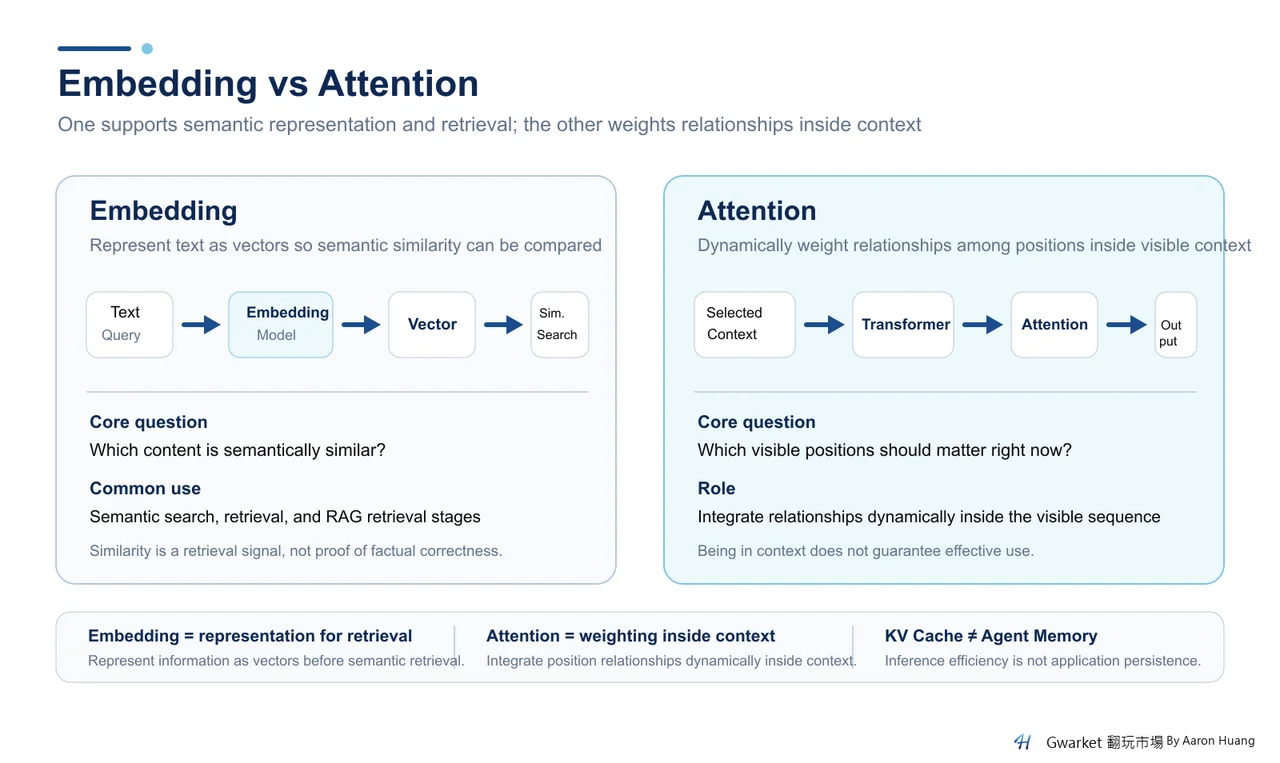
Attention explains how a model dynamically references positions in the current sequence. Embeddings explain how text can be represented as vectors so semantic similarity can be computed.
That distinction helps make several engineering questions concrete:
- Why does long context have real computational cost?
- Why does putting information into context not guarantee the model will use it well?
- Why can embeddings support semantic search?
- Why is a vector database not the whole RAG system?
- What does a KV cache actually save?
You do not need to calculate attention by hand.
You need enough understanding to make engineering decisions.
1. The Transformer Was Not Invented to “Make AI Chat”
The 2017 paper Attention Is All You Need introduced the Transformer in the context of sequence transduction, including machine translation.
Earlier recurrent sequence models typically processed information step by step:
token 1
   ↓
token 2
   ↓
token 3
   ↓
token 4
Earlier information had to be propagated through a chain of hidden states.
The Transformer made attention a central mechanism for connecting positions in a sequence more directly, while also making training more parallelizable.
A simplified intuition is:
token A ─┐
token B ─┼─→ which positions matter to the current position?
token C ─┤
token D ─┘
One boundary matters:
The original 2017 Transformer was an encoder-decoder architecture. It is not the complete architecture of every modern generative LLM.
Modern LLMs include many later design changes.
For application engineering, the durable idea is that the model repeatedly asks a question similar to:
Which positions in the visible sequence are useful for representing the current position?
2. Self-Attention: What Should This Token Refer To?
Consider:
The bank approved the loan because it was financially stable.
When the model processes it, looking only at the immediately previous token is not enough.
It needs to use the visible sequence to estimate relationships among:
itbankloanfinancially stable
A useful intuition for self-attention is:
For the current position, how much should each other visible position matter?
This is not a database lookup and it does not return a single guaranteed-correct record.
It is a dynamic weighting process.
The same token in a different sentence can participate in different attention relationships.
This is why Context Engineering cannot stop at:
Is the information present?
You also care about:
Can the model use the relevant information effectively within this context?
3. Q, K, and V Matter — But You Do Not Need to Calculate Them
Scaled dot-product attention is commonly written as:
Attention(Q, K, V)
= softmax(QKᵀ / √dₖ)V
If your goal is application engineering, you do not need to calculate the matrices by hand.
A practical mental model is enough:
Query
= what signal is the current position looking for?

Key
= what matchable signal does each position expose?

Value
= what information should be brought back if the match is strong?
Queries and keys determine attention weights, which are then used to combine values.
That is enough to preserve four important engineering facts:
- Attention is dynamic and depends on the current input.
- Information being present in context does not guarantee high attention weight.
- Irrelevant or conflicting information can influence how other information is used.
- Attention is not deterministic database lookup.
So:
The context window answers “how much can be visible?” Attention helps determine “which visible positions matter to the current representation?”
These are different problems.
4. Multi-Head Attention Is Not “One Head for Grammar”
A sequence can contain many simultaneous relationships:
- syntax
- references
- topics
- time
- causality
- semantics
- position
Multi-head attention lets the model construct attention relationships through multiple learned projections.
A tempting oversimplification is:
Head 1 = grammar
Head 2 = reference
Head 3 = causality
Do not keep that as your mental model.
Real models do not generally expose such clean, fixed, human-named roles for every head.
A safer intuition is:
The model can observe sequence relationships through multiple learned representation subspaces at once.
That is usually enough for application design.
5. Embeddings: Representing Text as Vectors
Attention operates on relationships among positions in a visible sequence.
Embeddings answer a different question:
How can text be represented numerically so that semantic operations become possible?
A simplified example:
"apple"
   ↓
[0.21, -0.73, 1.02, ...]
Real vectors are much higher-dimensional.
A second point is more important: internal representations are contextual.
Compare:
I ate an apple.

Apple released a new device.
The same surface token participates in very different meanings.
So do not think of an embedding as:
one word → one permanent “AI dictionary coordinate”
Representation depends on model, task, and context.
6. Why Can Embeddings Support Semantic Search?
In applications, we often use a dedicated embedding model to map queries, sentences, paragraphs, or documents into vectors.
If the embedding model is suitable for the task, semantically related content should generally map closer together than unrelated content.
For example:
A. How can I reset my password?

B. I forgot my login credentials.

C. What's the weather today?
A and B use different words but are semantically related.
A basic semantic-search pipeline looks like:
User Query
    ↓
Embedding Model
    ↓
Query Vector
    ↓
Similarity Search
    ↓
Candidate Passages
This is why embeddings appear so often in RAG systems.
But one boundary is essential:
Vector similarity is not factual correctness.
Embedding similarity cannot guarantee that:
- the document is current
- the source is authoritative
- the chunk contains enough surrounding context
- top-k retrieval found the evidence you actually need
- the LLM will use the retrieved evidence correctly
So:
Embedding + Vector DB
≠
A complete reliable RAG system
Retrieval is only one part of the chain.
7. Attention vs. Embeddings
If you keep only one table, keep this one:
| Concept | Core question | Application intuition |
|---|---|---|
| Embedding | How is this information represented as a vector? | similarity, semantic search, clustering, retrieval |
| Attention | Which positions in the current sequence should matter to this position? | dynamic relationship weighting, context integration |
The shortest useful memory aid is:
Embedding
= Representation

Attention
= Dynamic relationship weighting
This is not a complete mathematical definition, but it prevents one common mistake:
Embedding is not attention, and vector search is not the same thing as attention inside the model context.
In a typical RAG system, they can appear in different stages:
Document / Query
    ↓
Embedding
    ↓
Semantic Retrieval
    ↓
Relevant content enters Context
    ↓
LLM / Transformer
    ↓
Attention integrates positions inside Context
    ↓
Generation
Every step can fail, which is why RAG evaluation should not examine only the final answer.
8. Why Does Attention Make Long Context a Real Resource Cost?
In full self-attention, if sequence length is n, each position may need pairwise attention interactions with other positions.
A simplified size relationship is:
n ↑

possible pairwise interactions
≈ n²
This is one reason long context is not only “more tokens on the bill.” It also has real compute and memory implications.
Later techniques improve different bottlenecks.
FlashAttention, for example, is an IO-aware exact-attention algorithm. Its central idea is to reduce expensive memory traffic between GPU memory levels through tiling rather than replacing attention with an approximate result.
Modern models may also use sliding-window attention, sparse attention, or other architectural techniques.
So do not infer:
“Double the context means every API must be exactly four times slower.”
Actual latency, cost, and memory use depend on:
- model architecture
- serving implementation
- hardware
- batching
- cache behavior
- attention implementation
The engineering conclusion is simpler:
Context length is a real systems resource, not free capacity.
9. KV Cache: Why the Model Does Not Recompute Everything for Every New Token
Autoregressive generation produces one token after another.
Suppose the model has already processed:
A B C D
When generating the next token, recomputing the keys and values for A, B, C, and D at every step would repeat a large amount of work.
A KV cache stores previously computed key/value states so they can be reused during later generation steps.
Conceptually:
Without KV Cache

A
A B
A B C
A B C D
→ recompute prior K/V repeatedly
With caching:
cached K/V for A B C
+
compute new K/V for D
Current Hugging Face Transformers documentation describes KV caching as a core inference optimization for autoregressive models because it avoids repeated computation for previous tokens.
But cache memory is not free.
Longer context usually means more cached state to retain, which can affect:
- GPU memory
- concurrency
- batch scheduling
- latency
- serving cost
An application engineer does not need to implement a KV cache from scratch.
But you should understand why:
Context length, generation speed, memory pressure, and concurrency are often part of the same serving problem.
10. What Should an AI Application Engineer Actually Remember?
You do not need to derive a Transformer to build useful AI applications.
You do need this map:
Text
 ↓
Token / Representation
 ↓
Transformer
 ↓
Attention integrates relationships inside context
 ↓
Generation
And outside the model:
Document / Query
 ↓
Embedding Model
 ↓
Semantic Retrieval
 ↓
Relevant content
 ↓
Context
 ↓
LLM
These pipelines connect inside an AI application, but they solve different problems.
Five conclusions are worth keeping:
- Attention and embeddings solve different problems.
- Information being in context does not guarantee effective use.
- Embedding similarity does not prove factual correctness.
- Long context has real compute and memory costs.
- KV cache is an inference-efficiency mechanism, not Agent Memory.
The last distinction matters especially for later Agent articles.
The next article moves back up the application stack:
If the model is probabilistic, how do we turn its output into something software can parse and use reliably?
That is where Prompt Engineering, Structured Output, Tool Calling, and Sampling come in.
Sources and Verification Scope
This article extends the Hello-Agents Chapter 3 study material. The following sources were rechecked on September 21, 2026.
The article intentionally does not:
- treat the original 2017 Transformer as the complete architecture of every current LLM
- convert one attention-complexity statement into a universal API latency or pricing rule
- claim that attention heads have fixed human-interpretable jobs
- treat embedding similarity as factual correctness
- expand into vector database selection, chunking, reranking, hybrid search, or embedding benchmarks
Primary references:
- Vaswani et al. — Attention Is All You Need
https://arxiv.org/abs/1706.03762 - Dao et al. — FlashAttention: Fast and Memory-Efficient Exact Attention with IO-Awareness
https://arxiv.org/abs/2205.14135 - Hugging Face Transformers — Cache strategies / KV cache
https://huggingface.co/docs/transformers/en/kv_cache - Sentence Transformers — Semantic Search
https://www.sbert.net/examples/sentence_transformer/applications/semantic-search/README.html - Datawhale / Hello-Agents — Chapter 3
https://github.com/datawhalechina/hello-agents/blob/main/docs/chapter3/%E7%AC%AC%E4%B8%89%E7%AB%A0%20%E5%A4%A7%E8%AF%AD%E8%A8%80%E6%A8%A1%E5%9E%8B%E5%9F%BA%E7%A1%80.md