The Model Can Be Fine and the System Can Still Fail: What Does Production AI Reliability Actually Mean?
In the previous article, we looked at prompts, Structured Output, Tool Calling, and nondeterministic testing.
That led to an important shift in perspective:
An AI application is not a prompt. It is a software system that contains a probabilistic model.
That immediately raises another question.
Suppose:
- the prompt is clear,
- the output schema is valid,
- the tool call succeeds,
- and a few test cases look fine.
Is the system ready for production?
Not necessarily.
In real production environments, systems rarely fail because “the model completely broke.”
More often:
several layers fail slightly, and the combined result becomes unreliable.
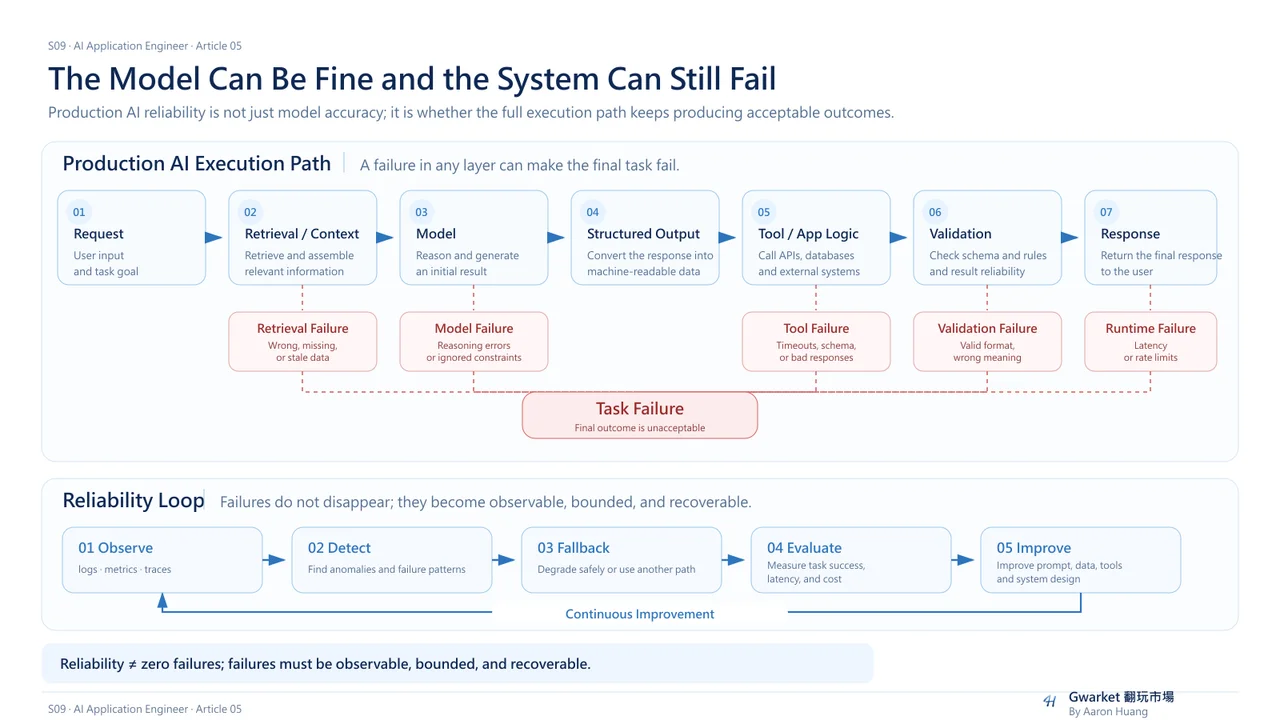
1. Production AI Is Not Just About Model Quality
Many AI demos ask a simple question:
Does the model give a good answer?
Production AI has to answer a harder one:
Can the entire system consistently produce an acceptable outcome?
Consider a customer-support application:
User
↓
Retrieve customer data
↓
LLM
↓
Tool call
↓
Order system
↓
Validation
↓
Final response
Any layer can fail:
Retrieval returns the wrong data
Tool request times out
API schema changes
Model ignores an instruction
Validation misses an invalid result
Fallback never activates
The model itself may be functioning exactly as expected.
The product can still fail.
So Production AI reliability should not be reduced to:
Model Accuracy
A better mental model is:
System Reliability
=
Model
× Data
× Retrieval
× Tools
× Validation
× Runtime
× Monitoring
This is not a literal mathematical formula.
It is a systems reminder:
a weak layer can compromise the final outcome even when the model is good.
2. AI Failure Is Not One Kind of Failure
Traditional software errors are often explicit.
For example:
HTTP 500
Database connection failed
NullPointerException
AI systems can fail much more quietly.
A request may return:
- HTTP 200,
- valid JSON,
- normal latency,
- no exception,
and still produce the wrong answer.
That means AI applications need to think about at least two broad categories of failure.
Hard Failure
The system clearly breaks.
Examples:
API timeout
Tool unavailable
JSON parse error
Rate limit
Authentication failure
These failures are relatively easy to detect because they produce explicit technical signals.
Soft Failure
The system appears healthy, but the result is poor.
Examples:
The model misunderstood the task
Retrieval returned irrelevant documents
The tool was called with the wrong arguments
Important context was ignored
The output schema was valid but the judgment was wrong
This category is harder because:
The software did not crash. The product still failed.
That is one of the central differences between Production AI and conventional backend engineering.
3. Model Failure: The Model Is Not a Fixed Function
Even when:
Prompt is unchanged
Model is unchanged
Inputs look similar
behavior can still vary.
Possible causes include:
- input distribution changes,
- long or noisy context,
- conflicting instructions,
- sampling variation,
- difficult edge cases,
- provider model updates,
- degraded upstream data.
Production systems therefore cannot assume:
It passed yesterday
=
It will always behave the same tomorrow
A useful principle is:
LLM quality is not a one-time property. It is behavior that must be observed over time.
4. Retrieval Failure: RAG Does Not Automatically Make Answers Correct
Once a system adopts RAG, it is tempting to think:
We connected external knowledge, so hallucination is solved.
But retrieval can fail too.
A typical pipeline looks like:
User query
↓
Embedding
↓
Vector Search
↓
Retrieved Documents
↓
LLM
Several things can go wrong.
The Correct Document Is Never Retrieved
The answer exists, but the retriever does not find it.
Irrelevant Documents Are Retrieved
The content looks semantically similar but cannot actually answer the question.
Too Much Is Retrieved
Large amounts of context dilute the information that matters.
The Documents Are Outdated
The retrieval result used to be correct but is no longer current.
Ranking Is Poor
The useful document exists but appears too far down the result set.
The important question for a RAG system is therefore not:
Do we have retrieval?
It is:
Did the retriever place the information required for this task into the model's usable context?
That connects directly back to Context Engineering.
5. Tool Failure: Choosing the Right Tool Does Not Mean the Task Succeeded
In the previous article, we separated two responsibilities:
The model can decide:
Which tool?
Which arguments?
The surrounding application or runtime performs the actual operation.
That introduces another set of failure modes.
Suppose the model correctly requests:
get_order_status(order_id="A123")
but the API returns:
503 Service Unavailable
That is not a model failure.
Now consider a subtler case.
The API returns:
HTTP 200
but the payload is:
{
  "status": null
}
Technically, the tool request succeeded.
Operationally, the result may be useless.
Other common failures include:
Tool schema changes
Field names change
Rate limits
Timeouts
Partial responses
Permission errors
So Tool Reliability is not merely:
Did the API respond?
A better question is:
Did the tool return usable information for the task?
6. Validation: Model Output Should Not Automatically Become Action
Suppose a model returns:
{
  "refund_amount": 9000
}
The structure is valid.
The schema is valid.
But the original order was only:
NT$900
The result still cannot be trusted.
Production AI often needs multiple layers of validation.
1. Syntax Validation
Can the output be parsed?
For example, is it valid JSON?
2. Schema Validation
Are the required fields, types, and enums correct?
For example:
priority ∈ {low, medium, high}
3. Business Rule Validation
Does the result satisfy deterministic application rules?
For example:
refund_amount <= order_amount
4. Semantic Validation
Does the result actually agree with the available evidence?
For example:
The model says the customer has already paid
but the source records contain no payment confirmation.
Semantic validation is harder.
Depending on the system, it may involve:
- deterministic rules,
- a secondary model,
- retrieved evidence,
- human review,
- deterministic computation.
Not every application needs every layer.
The key principle is simpler:
“The model returned something” is not the same as “the result is safe to use.”
7. Fallback: A Component Failure Does Not Have to Become a Product Failure
A mature system is not one that never fails.
It is one that knows what to do when failure happens.
One fallback might be:
Primary model
↓ fail
Fallback model
But fallback does not always mean changing models.
It could be:
AI answer unavailable
↓
Return deterministic search results
or:
Tool unavailable
↓
Ask the user to retry later
or:
Validation failed
↓
Do not produce a final answer
This is the idea of:
Graceful Degradation
The system may provide less functionality.
But it does not have to become unpredictable.
8. Retry Is Not a Universal Fix
When a timeout occurs, a common instinct is:
Retry
Sometimes that is correct.
A transient network failure may disappear on the next attempt.
But if the real cause is:
A bad prompt
An invalid tool schema
Missing source data
A repeatable model misunderstanding
retrying simply means:
repeating the same failure.
It may also increase:
- latency,
- cost,
- rate-limit pressure.
The better question is:
Is this failure retryable?
not:
Did something fail?
→ Retry everything
9. Observability: Without a Trace, You Do Not Know What Broke
Suppose a user says:
The AI seems worse today.
That statement alone is nearly useless for debugging.
The problem might be:
Prompt
Context
Retrieval
Model
Tool
Validation
Runtime
If the application records only:
User input
Final answer
you cannot see what happened in between.
That is why Production AI needs:
Observability
At minimum, engineers often need to answer questions such as:
Which model handled this request?
Which prompt or instruction version was used?
What context was supplied?
Which documents were retrieved?
Which tools were called?
How long did each tool take?
What status did the tool return?
Did validation fail?
How many tokens were used?
What was the end-to-end latency?
This is why AI systems increasingly record a:
Trace
A request becomes an execution path rather than just an input-output pair.
10. Logs, Metrics, and Traces Are Different
These concepts are related, but they answer different questions.
Log
A record of an event.
For example:
tool_call_failed
Metric
A numerical summary of many events.
For example:
tool_failure_rate = 2.8%
Trace
A connected view of one complete request.
For example:
Request #8291

Retrieval   120ms
↓
LLM         1.8s
↓
Tool        420ms
↓
LLM         1.1s
↓
Validation  PASS
Traces are especially valuable in AI applications because a single result is often produced by several interacting components.
11. Latency: Multi-Step AI Systems Become Slow Quickly
Suppose:
LLM call = 2 seconds
That sounds acceptable.
But the real workflow might be:
Retrieval          0.3s
LLM                2.0s
Tool               0.8s
LLM                1.7s
Validation Model   1.5s
Now total latency is already:
6.3s
Add retries and it can easily become:
10s+
So Production AI should not optimize only:
Single-model latency
The relevant measure is:
End-to-End Latency
That is what the user experiences.
12. Cost: Every Additional Model Call Has a Price
AI workflows can easily evolve into:
Main LLM
↓
Critic LLM
↓
Rewrite LLM
↓
Validation LLM
Quality may improve.
But cost also rises.
Then add:
long context
retrieval
tool usage
retry
and the real cost per request can become much higher than expected.
The production question is therefore not simply:
Which model performs best?
It is:
Is this quality improvement
worth the added
cost + latency + complexity?
That is an engineering trade-off.
13. Evaluation Is Not a One-Time Exam Before Launch
AI evaluation is often treated like:
Run a benchmark before release.
Production systems need more than that.
Two broad evaluation loops are useful.
Offline Evaluation
Test against a controlled dataset.
For example:
100 customer-support cases
Re-run the set whenever you:
- change the prompt,
- switch models,
- modify retrieval,
- change the tool schema.
This is useful for regression detection.
Online Evaluation
Observe what happens under real traffic.
Depending on the product, useful signals might include:
task success rate
tool failure rate
fallback rate
human escalation rate
user correction rate
latency
cost
Offline evaluation asks:
Did the change make performance worse on cases we already understand?
Online evaluation asks:
What is happening in the real world now?
Neither replaces the other.
14. Do Not Measure Only “Answer Quality”
A single:
Answer Quality Score
is often not enough.
Production systems may need to monitor:
Task Success Rate
Schema Valid Rate
Tool Success Rate
Retrieval Hit Rate
Fallback Rate
Latency P95
Cost per Request
The correct metrics depend on the product.
A support assistant and a coding agent should not automatically share the same KPI set.
So instead of asking:
What are the standard KPIs for AI applications?
start with:
What must this system actually succeed at?
Then work backward to the measurements.
15. Reliability Does Not Mean Zero Errors
No production system can realistically promise:
100% never fail
Conventional systems cannot guarantee that.
AI systems certainly cannot.
Reliability Engineering is therefore about building a loop like:
Understand where failure can happen
↓
Detect it
↓
Limit the impact
↓
Recover
↓
Learn whether the system improved
A reliable system is not one that never fails.
It is one where:
failure is observable, bounded, and recoverable.
16. From Model Accuracy to Task Success
The central shift of this article can be summarized as:
Model Thinking

Is this model accurate?
        ↓

System Thinking

Did the task actually succeed?
        ↓
If it failed, which layer failed?
        ↓
Can the system detect that failure?
        ↓
Can it degrade safely?
        ↓
Can we tell whether the next version improved?
This is one of the biggest differences between a Model User and a Production AI Engineer.
17. A More Complete Production AI Loop
Putting everything together:
Request
↓
Context / Retrieval
↓
Model
↓
Structured Output
↓
Tool / Application Logic
↓
Validation
↓
Response
↓
Observability
↓
Evaluation
↓
Improve
At this point, one thing becomes obvious:
The LLM is only one component in the system.
The model matters.
But Production AI quality depends on whether the entire execution path is:
- designed,
- validated,
- observable,
- measurable,
- and recoverable.
18. What Does This Have to Do With Agents?
Everything in this article can exist without an Agent.
A normal:
RAG + LLM + Tool
application already has to deal with:
- failure,
- validation,
- fallback,
- observability,
- latency,
- cost,
- evaluation.
That distinction matters.
These are not:
Agent-only problems.
They are:
Production AI problems.
Agents simply amplify them.
Because once a model begins to:
Observe
↓
Decide
↓
Act
↓
Observe again
the system is no longer performing a single input-output transformation.
It begins to form a:
closed loop.
And that leads directly to the next article:
What exactly is an AI Agent?
The answer is not simply “an LLM with tools.”
The important question is whether the system can repeatedly observe outcomes, make decisions, and continue acting toward a goal.