LLMs Are Not Knowledge Bases: Why Next-Token Prediction Can Produce Confidently Wrong Answers
If you are learning about AI agents, it is tempting to start with tool use, MCP, RAG, multi-agent systems, or memory. But all of those ideas sit on top of a more basic question:
What is an LLM actually doing?
If the mental model is wrong here, the architecture built on top of it can be wrong too.
The central distinction is:
The autoregressive LLMs discussed here estimate the conditional probability of the next token from the information currently available, then repeat that process step by step. Producing plausible language is not the same thing as verifying facts. 1
That does not make an LLM a useless autocomplete system. Large language models can learn complex patterns involving language, concepts, code, task structure, and some forms of reasoning. The useful engineering model is this: an LLM can be highly capable while still being one probabilistic generation component inside a larger AI system. 2
A qualification to the title: “not a knowledge base” does not mean “contains no knowledge.” Model parameters can encode factual relationships learned during training. The mistake is treating generated answers as database lookups with guaranteed provenance, version control and claim-by-claim verification. This article focuses on autoregressive text generation, not every language-model architecture. 3 4
Contents
- 1. What should the next token be?
- 2. Why can prediction produce complex capabilities?
- 3. Why does context change the answer?
- 4. Why is fluent output not necessarily correct?
- 5. When does the system need more than an LLM?
- 6. Model, product, application and agent
- 7. What does the engineer design?
- 8. Five misconceptions
- 9. Conclusion
- Sources and verification scope
1. The Basic LLM Question: What Should the Next Token Be?
A token is a unit of text processed by a model. It is not necessarily one English word or one Chinese character; the exact segmentation depends on the tokenizer.
For this article, the important part is the prediction problem:
Given the sequence so far, what is likely to come next?
A simplified expression is:
P(x_n | x_1, x_2, ... x_(n-1))
After seeing the preceding tokens, the model estimates a probability distribution over possible next tokens.
The following is a conceptual example, not a measured model output. Suppose the input is:
The capital of France is
The generation operation is not a database query that fetches a completed sentence. A useful conceptual view is:
Current input
    ↓
Estimate the next-token candidate distribution
    ↓
Select the next token according to the generation strategy
    ↓
Append the token
    ↓
Predict again
    ↓
Repeat
A response is produced through autoregressive generation: each generated step becomes part of the input to the next step. 1
The first important distinction is:
An answer is generated under the current conditions, rather than retrieved through one database query. This does not mean a model can never reproduce text encountered during training.
2. If It Is “Just Next-Token Prediction,” Why Can It Code, Translate, or Reason?
One common oversimplification is:
“If an LLM only predicts the next token, it does not really have any capability.”
The objective sounds simpler than the structure involved in performing it well. Learning from large and diverse datasets can yield reusable patterns involving:
- grammar and style
- relationships between concepts
- question-and-answer structure
- common code patterns
- translation and summarization correspondences
- regularities demonstrated in tasks and examples
So a next-token objective does not imply that the model learns only superficial word transitions.
Large language models can develop representations and reuse learned patterns across tasks. The GPT-3 study demonstrated translation, question answering and some tasks involving on-the-fly reasoning, while also documenting failures and limitations. It did not establish universal reliability. 2
It is also important to distinguish pretraining from post-training. Next-token prediction is not a complete description of every training stage. InstructGPT, for example, used supervised fine-tuning on demonstrations followed by reinforcement learning from human feedback. The study reported improvements in some truthfulness evaluations, but the models still made mistakes. 5
The opposite mistake is:
“If the model can reason, then what it says must be true.”
That conclusion does not follow either.
Capability and reliability are different dimensions.
A model can generate apparently reasonable reasoning from a false premise. It can also produce a polished explanation containing a wrong date, unsupported number, invented source, or incorrect name that has not been externally verified.
A more precise statement is:
Next-token prediction is a starting point for understanding autoregressive models, not a complete training recipe. Learned capabilities do not automatically guarantee factual correctness, freshness, reproducibility or safety.
3. Why Can the Same Model Give Different Answers in Different Situations?
Treating the model as the entire system misses a large part of how AI applications work.
A useful engineering abstraction is:
Output = f(Model, Context, Sampling)
This is not a formal universal equation. It is a teaching model for thinking about where an output comes from.
Context can include much more than the user's latest message:
- system or developer instructions
- conversation history
- user-provided documents
- retrieved passages
- tool results
- demonstrations or examples
- output-format requirements
Sampling affects how the system selects from the model's candidate token distribution.
The engineering consequence is important:
Output quality is not determined by model capability alone.
When investigating a poor result, check for:
- an unclear task
- missing authoritative information
- conflicting context
- too much irrelevant context
- an overly unconstrained output space
- missing validation after generation
These are diagnostic possibilities, not established root causes. Research on long contexts also distinguishes input capacity from effective use of information; findings for a particular set of models should not be treated as universal results for every newer model. 6
That is why “Should we use a stronger model?” can be a premature debugging question.
The model is one component in the system.
4. Why Can an LLM Sound Excellent and Still Be Wrong?
When reading an answer, “sounds credible” should not be treated as equivalent to “is correct.”
A model can produce:
- a plausible person's name
- a correctly formatted date
- a paper title that sounds real
- a coherent causal explanation
- a highly confident tone
These are examples of claims to verify, not an error list from an experiment performed for this article. Fluent language does not establish reliable support for each claim. TruthfulQA evaluated whether tested models reproduced common misconceptions; it supports evaluating truthfulness separately, not assigning those historical error rates to all current models. 7
The distinctions matter:
Linguistic plausibility ≠ factual correctness
Confident tone ≠ high reliability
A complete answer ≠ verified reasoning
There is no need to start by attributing an error to deliberate deception. The more useful engineering interpretation is:
A generative system can produce plausible continuations without a guarantee that every factual claim has been externally verified.
Once you adopt that mental model, the application architecture starts to change.
5. When Is User → LLM → Answer Not Enough?
For low-risk work such as brainstorming, rewriting copy, or generating rough alternatives, direct generation may be reasonable.
The architecture becomes more demanding when the task depends on verifiable external facts.
Examples include:
- current rules or policies
- official company data
- order or account status
- research that requires traceable sources
- decisions that trigger downstream actions
In those cases, this pattern:
User → LLM → Answer
may need to become something closer to:
Authoritative Source
        ↓
Retrieval / API / Tool
        ↓
       LLM
        ↓
Citation / Validation
        ↓
      Answer
This is a risk-dependent design example, not a universal pipeline or a guarantee of zero errors. RAG combines external retrieval with generation, but retrieval can select the wrong material and the model can misinterpret it. Adding a citation does not establish that the cited material supports the claim; that still needs checking. 4
This does not mean every AI application needs RAG, search, tools, or an agent.
The more fundamental questions are:
What is the cost of being wrong? Does the answer require external evidence? Can the system verify the result?
The higher the risk, the less acceptable it is to treat “the model generated a convincing answer” as equivalent to “the system completed the task correctly.”
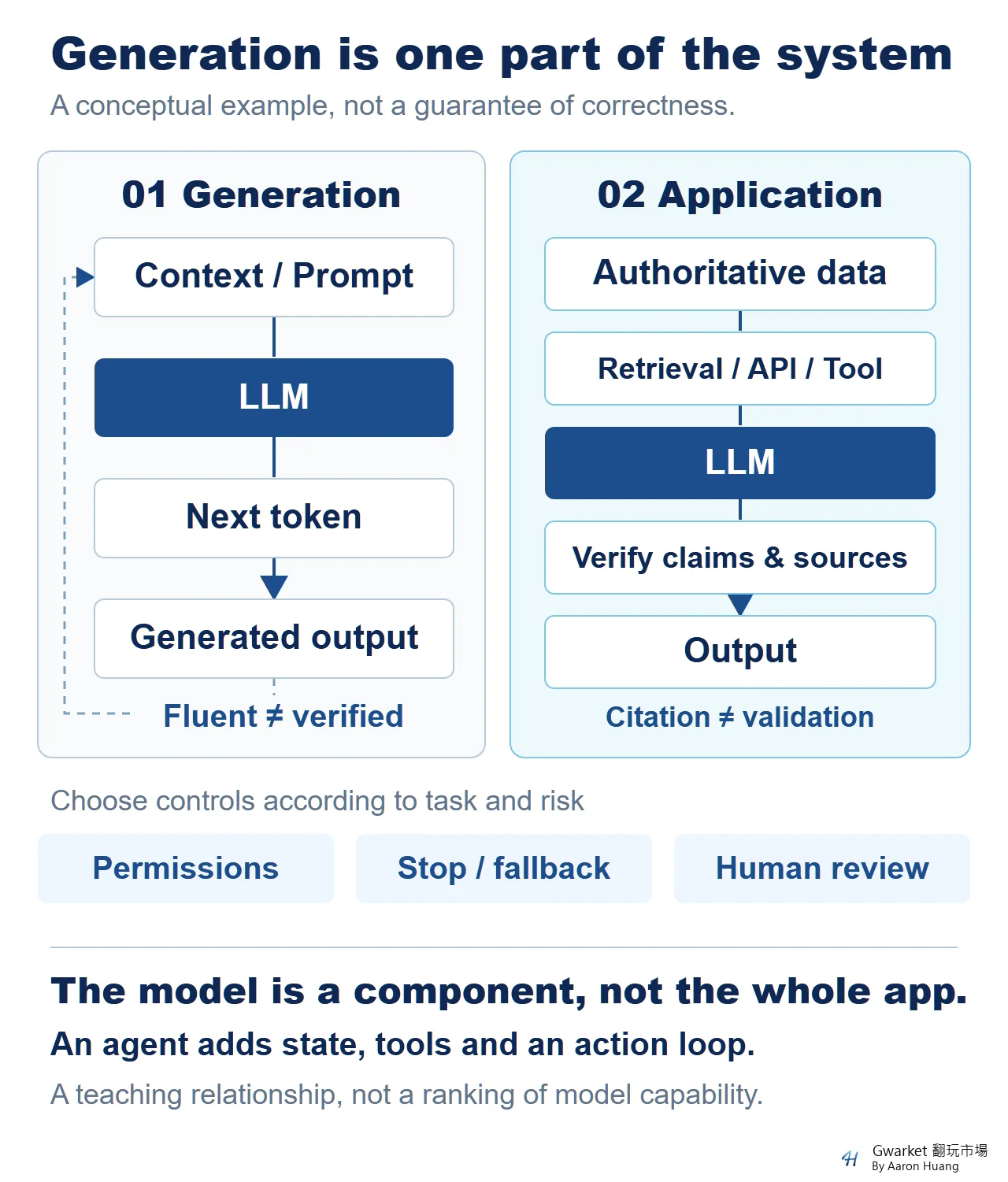
Figure: An original teaching illustration, not a model experiment. The right-hand pipeline is one possible application design; citations, validation and human review each have limitations.
6. Model, Chat Product, AI Application, and Agent Are Different Layers
Many AI discussions use these terms interchangeably. That makes it difficult to identify where capability or failure comes from.
A simple model is:
| Layer | Primary role | What it may contain |
|---|---|---|
| Model | Generate outputs | The LLM itself |
| Chat Product | Provide a conversational experience | Models, UI, search, files, memory, policies, tools |
| AI Application | Complete a specific task | Models, data, program logic, interfaces, permissions, validation, observability |
| Agent | Select subsequent actions from state and feedback | An AI application plus state, decision loops, tools, actions and governance |
Another conceptual view is:
LLM
= probabilistic generation component

AI application
= LLM + data + code + interface + controls

Agent
= AI application + state + tools + action loop + governance
This is not a universal industry definition or four mutually exclusive categories. A chat product can itself be an AI application containing an agent. Fixed workflows can also call tools. In the architectural distinction used here, an agent dynamically chooses subsequent steps from state and environmental feedback; merely adding a tool does not establish that distinction. 8
The key point is:
An agent is not simply “a more advanced model.” It is usually a system-level architecture or pattern built around models and other components.
So when an agent gives a wrong answer, calls the wrong tool, or continues when it should stop, the root cause may not be model capability.
It could be:
- incorrect context assembly
- bad tool data
- poorly designed permissions
- missing stop conditions
- missing validation
- an application that treats model output as trusted instructions
This is why learning agents cannot stop at prompt writing.
7. What Does an AI Application Engineer Actually Design?
Once you treat the LLM as a probabilistic generation component, the engineering problem becomes broader than “make the model answer.”
The real work is designing boundaries. The following questions are an engineering synthesis of the preceding discussion, not a single mandatory standard.
What should the model see?
Which information belongs in context, and which information should stay out?
Which facts must come from external systems?
Does the task require retrieval, an API, a database, or another tool?
Which outputs can be used directly?
A creative headline and a payment instruction do not have the same error tolerance.
Which results require validation?
Do you need to check format, sources, numbers, permissions, or require human approval?
What happens when the model fails?
Should the system retry, refuse, fall back, escalate to a human, or stop?
These are the questions that separate “using a model” from “designing an AI system.”
8. Five Common Misconceptions
| Common claim | More precise model |
|---|---|
| An LLM is basically querying a database | An LLM can encode knowledge, but generation is not a database query with guaranteed provenance and version control |
| It is only autocomplete, so it has no real capability | Next-token prediction can yield complex representations, but that does not make every output reliable |
| The answer is detailed, so it is probably true | Language quality and factual correctness are separate dimensions |
| A stronger model will solve every problem | Context, data, tools, validation and workflow design also shape system quality |
| An agent is a more advanced kind of LLM | An agent combines models, state, tools and a dynamic action loop at the system level |
9. Conclusion: Do Not Mistake a Probabilistic Generator for a Complete System
Understanding LLMs is not about diminishing what they can do.
It is about knowing where their capability ends and where system design begins.
LLMs are powerful at language, semantics and fuzzy patterns. They can exhibit complex generation and reasoning behavior. But the model itself does not inherently guarantee that:
- every factual claim is correct
- information is current
- outputs are identical every time
- every action respects the application's permissions and safety requirements
So the first question in AI application engineering should not be:
“How do I make the LLM do everything?”
A better question is:
“Which parts of this task can be handled by probabilistic generation, and which parts must be supplied by data, code, tools, validation, permissions, or human judgment?”
Once that boundary is clear, technologies such as RAG, tool use, validation, evaluation and agent architectures become specific answers to specific system problems.
The next article goes one layer deeper:
If an LLM's output depends on what it can see right now, how does that information enter the model? What is a context window, and why can adding more context sometimes make the system worse rather than better?
Sources and Verification Scope
This article extends the Hello-Agents Chapter 3 study material. Relevant original research abstracts and official documentation were checked on September 19, 2026. No model was trained or benchmarked for this article, and no current-model error rate is claimed. The diagram, shorthand formulas and pipelines are teaching models; the selection of system controls is engineering judgment. Historical study results do not describe every newer model.
- Hugging Face — Causal language modeling: autoregressive scope.
- Brown et al. (2020), Language Models are Few-Shot Learners: capabilities and limitations.
- Petroni et al. (2019), Language Models as Knowledge Bases?: factual relationships in model parameters.
- Lewis et al. (2020), Retrieval-Augmented Generation for Knowledge-Intensive NLP Tasks: parametric knowledge and retrieval; version 4 (2021).
- Ouyang et al. (2022), Training language models to follow instructions with human feedback: post-training and remaining errors.
- Liu et al., Lost in the Middle: How Language Models Use Long Contexts: input capacity versus effective information use.
- Lin et al., TruthfulQA: Measuring How Models Mimic Human Falsehoods: evaluating truthfulness separately.
- Anthropic, Building effective agents: workflows and agent architecture.
- Hello-Agents: Chapter 3 — Large Language Model Fundamentals: original study context.