This article synthesizes public Anthropic and Claude engineering material with Gwarket's analysis of verifiable AI workflows. It is not Anthropic documentation or a product commitment.
“Harness” sounds like infrastructure language, but it addresses a practical problem. You want an AI system to take initiative, yet you do not want it to read the wrong material, retry forever, change an external system by mistake, or confuse a polished answer with a completed task.
The model is the part that reasons and decides how to use available capabilities. A harness is the work environment around it: the information it receives, the tools it can use, the conditions that stop it, and the boundaries that require a person to decide.
It is not another agent. It is also not just a long prompt.
What a harness contains
| Component | Practical question |
|---|---|
| Context | What information may the agent rely on? |
| Tools | What may it read, search, write, or call? |
| Workflow | What has an order, and when does the run end? |
| Boundaries | What may not happen without approval? |
| Observability | How can someone inspect what happened later? |
For a content-research task, a minimal harness might say: read only this source set; separate supported claims from unknowns; propose three angles; do not publish; stop and ask when sources conflict. Those rules do not decide the argument for the model. They make the path to a candidate result inspectable.
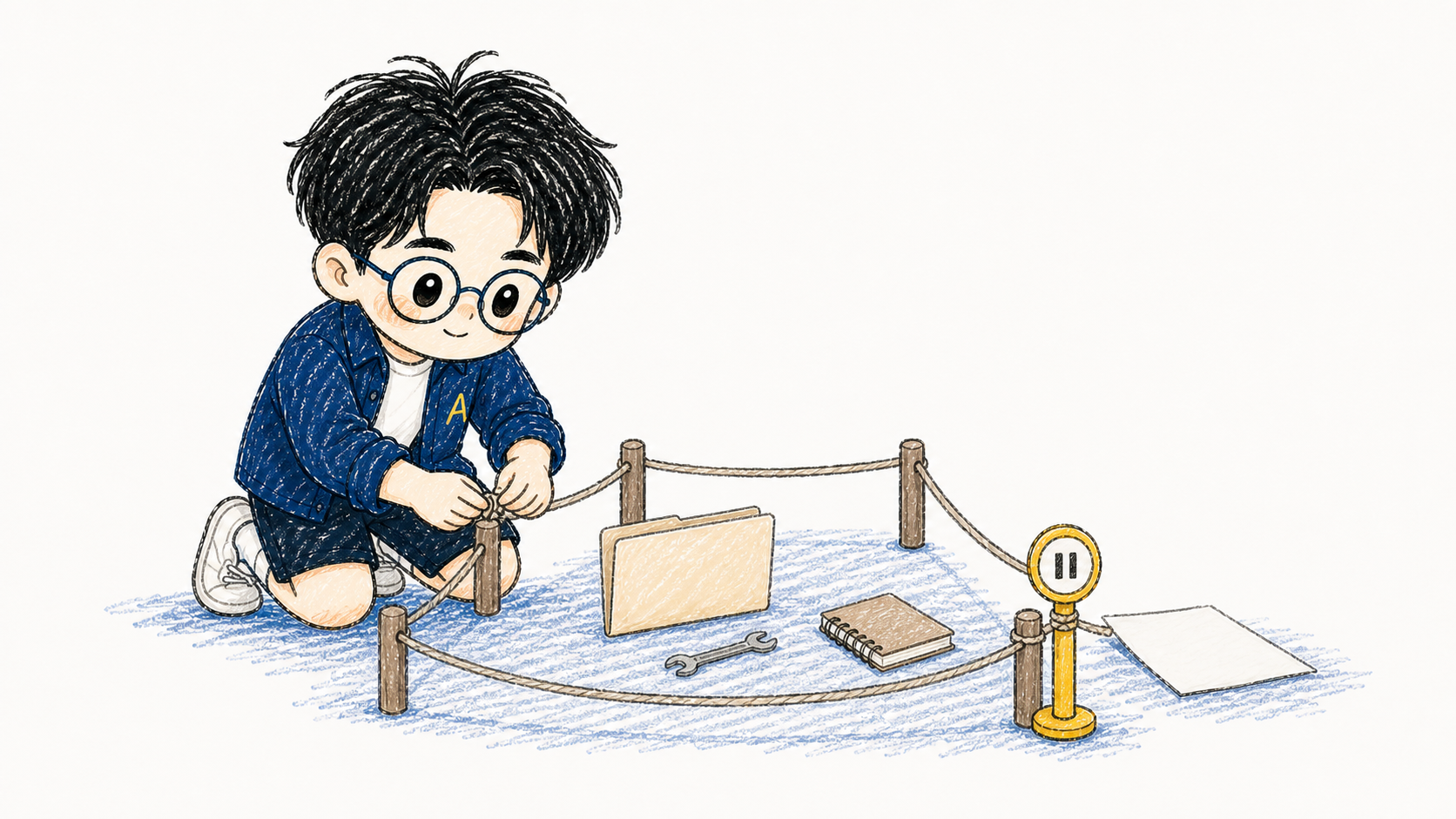
When it becomes worth writing down
One-off exploration normally does not need a formal harness. It becomes useful when work repeats, uses real tools, passes between people, or has a meaningful failure cost.
This is similar to onboarding a colleague. You would not only say “make this good.” You would explain the available materials, the place for the result, the actions that are off limits, and who owns difficult decisions. Many teams already have these rules, but they live in the memory of experienced people. A harness turns them into something reviewable and reusable.
Start with the smallest useful version
You do not need to build a complex system. A minimum content workflow can begin with five rules:
- Preserve the source material, not only the final summary.
- Label each important statement as sourced or inferred.
- Keep missing evidence visible rather than filling it with certainty.
- Produce a candidate, not an automatic public release.
- Require a human decision before the next consequential stage.
That already changes a chat into a traceable work unit. If repeated failures show that the agent reads irrelevant material, then narrow the allowed context. If a predictable step breaks, add a check. Rules should grow from observed failure, not from an imagined list of every possible danger.
A harness should also be removable
The opposite error is to encode a rigid rule for every small action. As models and tools improve, those rules can become the bottleneck. Anthropic frames the design question well: what can the harness stop doing for the model?
Keep the structure that enforces security, user experience, or observability. Reconsider scaffolding that only compensates for an old limitation. A useful test is simple: what real risk does this rule still prevent, and what observable result would worsen if it disappeared? If neither answer is clear, the rule may be technical debt.
You do not need code to begin. A fixed output template, a clear source folder, a list of actions that require confirmation, and a completion checklist are already the beginnings of a harness.